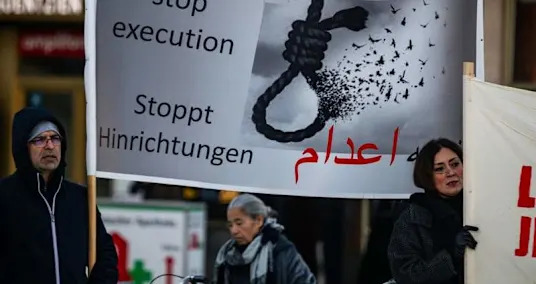
Two of those executed on Monday were killed without advance notice, denying them the chance to meet with their lawyers or say goodbye to their families, according to Amnesty International.
Iran executed two men tied to the People’s Mojahedin Organisation of Iran (PMOI), adding to two other men who were executed on Monday, the group said on Tuesday, confirming a report by Iran’s judiciary news outlet.
PMOI members, 34-year-old law school graduate Babak Alipour and 33-year-old electrical engineer Pouya Ghobadi, were killed on Monday after being convicted of links to the outlawed group and for alleged involvement in multiple attacks, including firing launcher weapons at a government building, according to the judiciary outlet.
Akbar Daneshvarkar, 60, and Mohammad Taghavi-Sangdehi, 59, were also hanged on Monday for alleged membership in Mujahideen-e-Khalq.
Daneshvarkar and Sangdehi were killed without advance notice, denying them the chance to meet with their lawyers or say goodbye to their families, according to Amnesty International.

Abolhassan Montazer and Vahid Bani Amerian, who were tried in the same case, are at imminent risk of death, and communication with the men has so far been impossible to establish, the NGO warned, adding that sources indicated all were subjected to torture during their detention.
“They were chivalrous men who did not bow to any torture or pressure and stood firm on their pledge and covenant until the very end,” Maryam Rajavi, president-elect of the Paris-based National Council of Resistance of Iran (NCRI), the political arm of the PMOI, said in a statement confirming the executions.
She said a number of PMOI members and other political prisoners remained on death row and called for international action to be taken to save their lives.
People’s Mojahedin Organisation banned in Iran
The NCRI, also known as PMOI, is banned in Iran, and it is unclear how much support it has there. However, along with its bitter rival – the monarchists backing Reza Pahlavi, exiled son of the toppled Shah – it is one of the few opposition groups able to rally supporters.
United Nations Special Rapporteur on human rights in Iran warned on Tuesday that, while the internet shutdown had made it difficult to monitor executions, it was “clear” the regime is using executions as “a means of suppressing political dissent amid war.”
United Nations Special Rapporteur on Human Rights and Counter Terrorism Professor Ben Saul added that he also condemned “Iran’s misuse of the death penalty in alleged security cases in violation of the right to life.”
LATEST POSTS
- 1
 Real time features for Films and Programs
 - 2Disability rights activist and author Alice Wong dies at 51
- 3Red Sea arena: Yemen’s Houthis open fourth front in Iran war, with global implications
- 4New study measures titanium in Apollo rock to uncover Moon’s early chemistry
- 5Conquering Language Boundaries: Individual Accounts of Multilingualism




- A Concise History Of The Entertainment world
- What to expect from the planets in 2026 — key dates and sky events
- Explainer-Why are hepatitis B vaccines given to newborns?
- Hezbollah claims right to respond to killing of top commander
- The most effective method to Really Adjust Hypothesis and Practice in Your Brain science Studies
- Surge of off‑lease electric vehicles expected to drive down used EV prices
- After fleeing past Hezbollah fighting, some Israelis on northern border vow to stay
- Argentina reportedly delaying embassy move over Israeli company's oil project near Falklands
- I watched the buzzy new AI documentary — and left feeling both hopeful and terrified